Excerpt from the Book I’m Writing:
I have begun writing a book called The Design and Operation of Industrial Glass Furnaces. The follwiing is an excerpt from Chapter 6: Furnace Hot Repair and Maintenance
Superstructure Repairs
The walls of the combustion space include breastwalls and end walls. Depending on the type of furnace these walls may have port or doghouse arches. The material of choice, that leaves the least of problems, is fused cast AZS. Some manufacturers opt for bonded materials which may be prone to failure.
The simplest of repairs is sealing at expansion joints and around openings or features. Just as with crown repairs, small holes can be filled with mortar. It is common to use a heat set mortar and an industrial grade caulking gun.
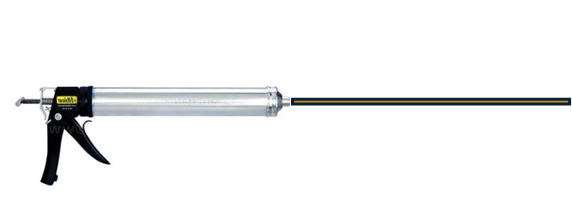
The mortar needs to be thick and plastic enough to be pumped through such a gun and adhere to refractory. When peephole or burner blocks are changed, this type of caulking works well to seal gaps around the perimeter.
More advanced repairs are needed when the integrity of the wall is jeopardized. The walls rely on tuckstone blocks for support. The tuckstones can crack or degrade especially at the charge end of the melter where batch piles can rub against them. Failure of the tucks can result in tipping of superstructure walls. Another cause of tipping is failure of the tuckstone support steel. The tuckstone are only partially supported by steel at the cold side and typically cantilever over the tops of the sidewall blocks. If the sidewalls are overcoated to the point that the tuck steel is buried, it can exceed the temperature limits and become ductile. This can result in the wall tipping in. There have also been issues with furnace designers miscalculating the load on the tuckstones and not using thick enough steel to support the walls. In these cases, there are options based on furnace design and access including pinning from the outside, hot replacement, and water-cooled pins from the inside.
Pinning walls from the outside involves drilling 19 or 25 mm holes to a depth of 50 to 75 mm into the cold face of the blocks. Stainless steel anchor bolts are then set into the blocks. The bolts can be welded to furnace steel. Once complete, measurements of the wall pitch should be made and monitored to see if the wall has indeed been stabilized or if more repairs are needed. This technique can also be used on port and doghouse arches when they have started tipping in.
Wall replacement is sometimes an option. If access if clear and there are no furnace features such as ports or arches that would be compromised by cutting out sections of the wall, the water-cooled chain saw has been very effective at surgical replacement of superstructure walls. These are the same kind of chainsaws used for concrete.
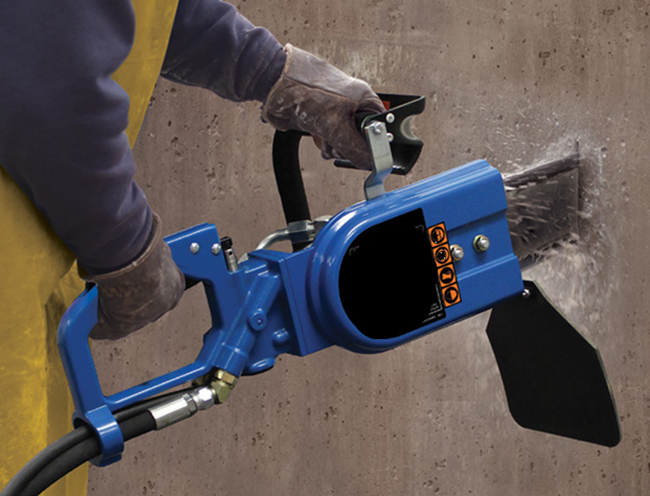
This was a common problem with early oxy-fuel furnaces and high velocity burners. These burners proved effective at wearing out the walls opposite them. Providing that the tuckstones are in good condition, the chainsaw can be used to cut out manageable sections of the wall and then masons can lay new refractory bricks in the furnace.
Walls or arches that have limited access for repair and can’t be pinned from the outside, can be pinned from the inside. This was the case with a side port furnace in the lighting industry. A breastwall was compromised and the one of the ports was tipping inward. This was a case where the tuckstones had failed because the support steel can become ductile. 2 meter long “hair pin” coolers were fabricated. Holes were drilled through the crown above the tipped port, large enough to accommodate the coolers. Two of these water coolers were lowered down approximately one meter into the furnace so that they “caught” the port and would support it. Outside, the coolers were sealed into the crown with patch material. This repair lasted until the furnace was shut down two years later. The biggest concern with this approach is that should water pressure be lost, the coolers would need to be removed. If they could not be removed, they could be saved if the water was restarted slowly and carefully. Any time one must restart flow on a hot water jacket it is necessary to introduce minimal water at first and slowly increase flow. Too fast a restart can cause a water jacket to thermal shock or fail from steam build up,
